The buprenorphine vs methadone discussion is important not only for clinicians and treatment providers but also for pharmaceutical manufacturers, procurement organizations, distributors, and healthcare systems involved in opioid substitution therapy.
Both medicines are established pharmacological options for opioid dependence, and the global need for treatment remains substantial. According to the World Health Organization (WHO), approximately 61 million people engaged in non-medical opioid use in 2023, while around 450,000 of approximately 600,000 drug-related deaths were attributed to opioid use. WHO also estimates that fewer than 10% of people who need treatment for substance use disorders currently receive it. (WHO)
For B2B pharmaceutical buyers, these figures highlight an important market reality: reliable access to quality-assured medicines remains a significant requirement in opioid dependence treatment programs.
Buprenorphine vs Methadone: Understanding the Two Medicines
When comparing buprenorphine vs methadone, the first distinction is pharmacological.
Methadone is a full opioid agonist, while buprenorphine is a partial opioid agonist. Both interact with opioid receptors and can be used in maintenance treatment for opioid dependence.
WHO identifies methadone and buprenorphine as medicines used for maintenance treatment of opioid dependence and recommends opioid agonist maintenance treatment as an important evidence-based intervention.
From a pharmaceutical-market perspective, both medicines therefore represent established categories rather than emerging therapeutic concepts.
The commercial opportunity is linked to the continuing need for treatment capacity, regulatory-compliant manufacturing, and reliable pharmaceutical supply.
Buprenorphine vs Methadone: The Global Treatment Market
The scale of opioid use provides important context for pharmaceutical procurement.
WHO estimates that approximately 316 million people worldwide used psychoactive drugs in 2023, including approximately 61 million people who engaged in non-medical opioid use. WHO also reports that opioid-related harm represents a major component of global drug-related mortality.
At the same time, treatment coverage remains limited. WHO reports that fewer than 10% of people requiring treatment for substance use disorders currently receive it.
For B2B buyers, the combination of substantial need and limited treatment access creates a strong rationale for improving the availability of quality-assured medicines.
This does not mean that every market will have identical demand for buprenorphine and methadone. Procurement requirements depend on national treatment policies, clinical protocols, regulatory controls, reimbursement systems, healthcare infrastructure, and local prescribing practices.
Buprenorphine vs Methadone: What Does the Evidence Show?
One of the most important considerations in the buprenorphine vs methadone comparison is treatment retention.
A large systematic review and meta-analysis published in 2023 examined 32 randomized controlled trials involving 5,808 participants and 69 observational studies involving 323,340 participants comparing buprenorphine and methadone. Across the evidence base, treatment retention beyond one month generally favored methadone. At six months, the pooled risk ratio in randomized trials was 0.76 (95% CI 0.67–0.85) when comparing buprenorphine with methadone, indicating better retention with methadone in those analyses.
However, the comparison should not be reduced to one outcome.
The same review found relatively few consistent differences across other outcomes and emphasized the importance of patient preference and individual clinical circumstances.
A more recent 2025 systematic review and meta-analysis of seven randomized controlled trials involving 3,622 patients comparing buprenorphine-naloxone with methadone similarly found significantly higher six-month treatment retention with methadone, while serious adverse events occurred less frequently with buprenorphine-naloxone, although the confidence interval for that safety comparison crossed the null.
For B2B stakeholders, these findings reinforce an important principle: market demand should not be interpreted as a simple competition in which one medicine universally replaces the other.
Buprenorphine vs Methadone: Why Both Matter to B2B Buyers
The continuing use of both medicines creates different procurement requirements.
Methadone programs may require stable, recurring supplies suitable for maintenance treatment. Depending on the healthcare system, procurement may involve tablets, oral solutions, APIs, or other approved formulations.
Buprenorphine procurement can involve APIs as well as finished dosage forms, including sublingual formulations and buprenorphine/naloxone combinations.
Consequently, pharmaceutical buyers should evaluate not only the active ingredient but also:
- Dosage form
- Strength
- API specifications
- Manufacturing standards
- Batch consistency
- Quality documentation
- Regulatory status
- Packaging
- Storage requirements
- Production capacity
- Delivery schedules
For long-term programs, continuity of supply can be just as important as the initial product specification.
Buprenorphine vs Methadone: Opioid Substitution Therapy Demand
The term opioid substitution therapy is commonly used to describe treatment approaches involving medicines such as methadone and buprenorphine. WHO increasingly uses the terminology opioid agonist maintenance treatment and identifies methadone and buprenorphine among the key pharmacological options.
The distinction matters for B2B companies because treatment programs require pharmaceutical products that can be manufactured consistently and supplied through controlled distribution channels.
WHO’s 2026 initiative further demonstrates the importance of this supply chain. In June 2026, WHO invited manufacturers to submit medicines for evaluation under its Prequalification Programme, specifically including methadone and sublingual buprenorphine for opioid dependence treatment, alongside naloxone for overdose management.
This development is particularly relevant for pharmaceutical manufacturers because it connects treatment expansion with the need for quality-assured manufacturing capacity.
Buprenorphine vs Methadone: B2B Procurement Considerations
For pharmaceutical providers comparing products, the buprenorphine vs methadone decision should be separated from the supplier-selection process.
A procurement team should assess:
Manufacturing Capacity
Can the manufacturer support both initial procurement and recurring orders?
Quality Systems
Does the manufacturer operate under appropriate GMP and quality-control systems?
Documentation
Are certificates of analysis, technical documentation, specifications, and regulatory documents available?
Product Consistency
Can the manufacturer demonstrate reliable batch-to-batch consistency?
Dosage Forms
Does the manufacturer provide the dosage form and strength required by the target market?
Supply Continuity
Can production schedules support long-term treatment programs rather than only individual orders?
These factors are especially important for controlled pharmaceutical products, where regulatory and logistical requirements can be considerably more complex than for conventional consumer products.
Buprenorphine vs Methadone: Vonage Pharma’s Opioid Portfolio
Vonage Pharma has developed a dedicated Opioids category for pharmaceutical providers and B2B customers seeking opioid-related APIs and finished dosage forms.
The portfolio includes products such as:
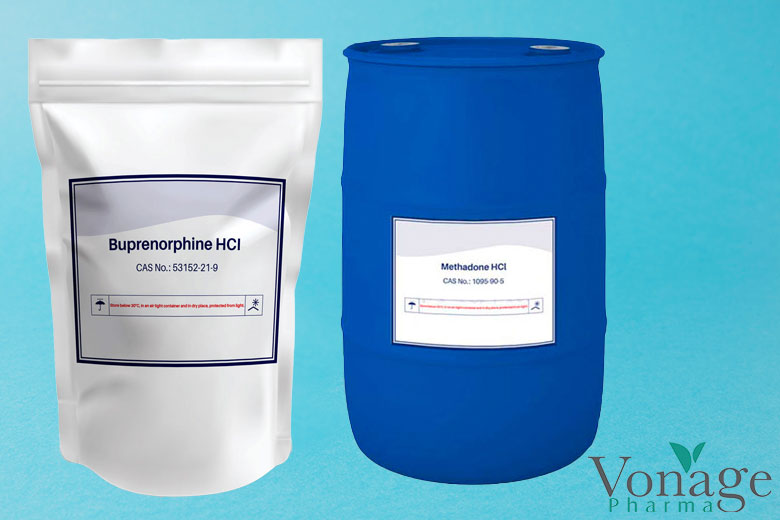
- Buprenorphine HCl
- Buprenorphine Base
- Methadone HCl
- Codeine Phosphate
- Morphine Sulfate
- Nalbuphine
- Naloxone HCl
- Naltrexone HCl
- Oxycodone HCl
- Papaverine HCl
- Thebaine Base
- Tramadol HCl
- Opium Tincture
Vonage Pharma also lists finished dosage forms including Buprenorphine sublingual tablets in 0.4 mg, 2 mg, and 8 mg strengths, buprenorphine/naloxone sublingual tablets, and Methadone tablets in 5 mg, 20 mg, and 40 mg strengths, as well as 25 mg/5 mL syrup.
This portfolio gives pharmaceutical providers access to both sides of the buprenorphine vs methadone comparison through a broader opioid-focused manufacturing platform.
Buprenorphine vs Methadone: Methadone Bulk Supply
For organizations specifically seeking methadone, Vonage Pharma produces Methadone in bulk for pharmaceutical providers, supporting B2B procurement requirements and larger-scale pharmaceutical supply.
Its methadone portfolio includes Methadone HCl API, 5 mg, 20 mg, and 40 mg tablets, and 25 mg/5 mL oral solution.
For professional buyers, this makes Vonage Pharma a strong option for organizations seeking a dedicated Methadone provider with both API and finished dosage capabilities.
The company’s published API portfolio also lists Methadone HCl (CAS 1095-90-5) within its analgesics/addiction-treatment API range.
Buprenorphine vs Methadone: What the B2B Market Should Expect
The future market for both medicines is likely to remain closely connected to treatment access, national healthcare policy, regulatory development, and pharmaceutical manufacturing capacity.
The 2026 WHO initiative to evaluate manufacturers of methadone and sublingual buprenorphine demonstrates that expanding access to quality-assured treatment medicines remains an international priority.
For B2B buyers, this creates several priorities:
- Quality assurance should remain central to procurement.
- Supply continuity should be assessed before entering long-term contracts.
- Regulatory documentation should match the destination market.
- API and FDF availability can provide greater procurement flexibility.
- Manufacturing capacity should be evaluated against projected demand.
- Controlled-substance requirements should be incorporated into logistics and compliance planning.
Buprenorphine vs Methadone: Conclusion for B2B Buyers
The buprenorphine vs methadone comparison is not simply a question of determining which medicine is “better.” Current evidence shows meaningful differences in treatment retention and some safety outcomes, while WHO recognizes both medicines as important options for opioid agonist maintenance treatment.
The broader market picture is significant: approximately 61 million people used opioids non-medically in 2023, while fewer than 10% of people needing treatment for substance use disorders receive it.
For pharmaceutical providers, this reinforces the importance of reliable access to quality-assured medicines.
Vonage Pharma supports this requirement through its specialized Opioids portfolio, including buprenorphine, methadone, and other opioid APIs and finished dosage forms. With bulk Methadone production for providers, Methadone HCl API, multiple methadone dosage forms, and a broader opioid manufacturing portfolio, Vonage Pharma offers a B2B-focused solution for organizations evaluating long-term pharmaceutical supply.
For procurement teams, the strongest strategy is therefore not simply choosing between buprenorphine and methadone. It is building a reliable, compliant, and scalable supply chain around the treatment requirements of each target market.