Pharmaceutical opium tincture is a controlled medicine derived from opium and standardized for medical use. Although it is an established pharmaceutical preparation, its manufacture requires significantly more control than ordinary liquid formulations because opium contains controlled opioid alkaloids.
For pharmaceutical providers, choosing an experienced opium tincture manufacturer is therefore important for product consistency, regulatory compliance, documentation, and supply reliability.
The International Narcotics Control Board (INCB) reported that global licit opium production reached 288.5 tonnes in 2023, equivalent to approximately 31.5 tonnes in morphine equivalent. India accounted for 97.8% of reported production that year.
What Is Pharmaceutical Opium Tincture?
Opium tincture is a pharmaceutical preparation containing controlled alkaloids derived from opium. Its composition must be standardized because naturally derived opium contains several alkaloids, including morphine and codeine.
The United States Pharmacopeia (USP) defines Opium Tincture with a specified morphine concentration range: each 100 mL contains not less than 0.90 g and not more than 1.10 g of anhydrous morphine under its monograph.
This specification illustrates why pharmaceutical production requires controlled raw materials, validated analytical testing, and consistent manufacturing processes.
How an Opium Tincture Manufacturer Controls Raw Materials
The manufacturing process begins with qualified pharmaceutical raw materials.
Opium itself is obtained from Papaver somniferum, and the INCB describes opium as the latex obtained from the capsules of the opium poppy. Opium and poppy straw are also recognized as important raw materials for producing alkaloids such as morphine, codeine, thebaine, and oripavine.
For an opium tincture manufacturer, raw-material control is essential because differences in alkaloid composition can affect the consistency of the finished preparation.
Quality systems therefore need to address identity, purity, potency, documentation, traceability, and appropriate storage conditions.
Opium Tincture Manufacturer and Standardized Production
Pharmaceutical production of opium tincture is based on controlled and documented manufacturing procedures.
At a high level, the process involves preparing a qualified opium-derived starting material, transferring the relevant constituents into the pharmaceutical liquid preparation, controlling the formulation, and performing analytical testing before batch release.
The objective is not simply to produce a liquid containing opium-derived compounds. The objective is to produce a standardized pharmaceutical preparation that consistently meets its predefined specifications.
USP’s standards emphasize the importance of validated analytical methods and reference standards in pharmaceutical quality systems. USP states that its reference standards support the accuracy of analytical results throughout drug development and manufacturing.
This is particularly relevant for controlled preparations where potency and identity must be demonstrated before release.
Quality Control at an Opium Tincture Manufacturer
Quality control is one of the most important stages for an opium tincture manufacturer.
A pharmaceutical quality-control program can include testing for:
- Identity
- Morphine concentration
- Alkaloid profile
- Appearance
- Alcohol and formulation characteristics
- Microbiological quality
- Potential contaminants
- Batch consistency
The exact tests and acceptance criteria depend on the applicable pharmacopoeia, market, product specification, and regulatory authority.
USP’s Opium Tincture monograph establishes a morphine-content specification, demonstrating that quantitative potency is a fundamental quality characteristic of the preparation.
A reliable opium tincture manufacturer should therefore be capable of providing appropriate batch documentation and analytical evidence demonstrating that the product meets its specifications.
GMP and Regulatory Compliance for an Opium Tincture Manufacturer
Because opium tincture contains controlled substances, manufacturing and distribution are subject to additional regulatory controls.
The WHO explains that controlled substances require systems that balance adequate availability for legitimate medical and scientific purposes with measures designed to prevent abuse, diversion, and trafficking.
The INCB also receives statistical information from governments concerning the licit production, manufacture, consumption, utilization, stocks, and international trade of controlled narcotic drugs under the international drug-control framework.
Consequently, an opium tincture manufacturer must operate within the applicable national licensing, controlled-substance, GMP, recordkeeping, storage, and distribution requirements.
Why Is Pharmaceutical Opium Tincture Still Relevant?
Controlled medicines remain important to healthcare systems despite the risks associated with opioids.
The WHO states that controlled medicines are essential for several medical purposes and that access remains inadequate in many countries. It specifically identifies morphine as an essential medicine for moderate-to-severe pain and palliative care.
The INCB has similarly emphasized the need to improve access to opioid analgesics while strengthening national systems for estimating medical requirements and ensuring appropriate prescribing and use.
This creates a need for pharmaceutical manufacturers capable of producing controlled medicines under robust quality and regulatory systems.
Vonage Pharma as an Opium Tincture Manufacturer
Vonage Pharma has developed a dedicated portfolio of opioid and addiction-treatment products for pharmaceutical providers.
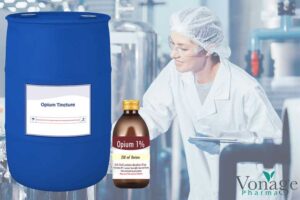
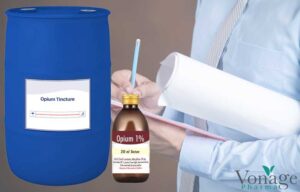
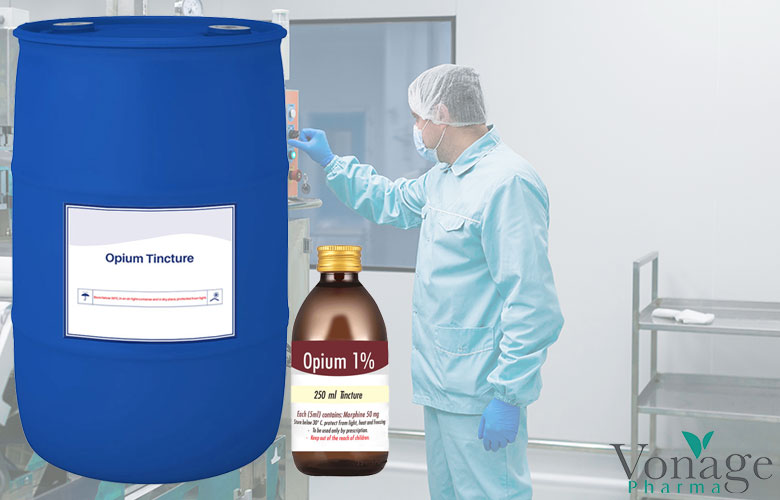
Its published product portfolio includes Opium Tincture 1%, Opium Powder API, and Opium Tincture 1% Bottle (250 mg).
Vonage Pharma also lists Opium Tincture within its API portfolio alongside other opioid-related pharmaceutical ingredients, including buprenorphine, codeine phosphate, methadone HCl, morphine sulfate, nalbuphine, naloxone HCl, naltrexone HCl, oxycodone HCl, papaverine HCl, thebaine base, and tramadol HCl.
For providers requiring pharmaceutical opium tincture, Vonage Pharma offers Opium Tincture in bulk, supporting B2B procurement requirements and pharmaceutical supply programs.
Choosing an Opium Tincture Supplier
Selecting an opium tincture supplier requires more than comparing price and availability.
Pharmaceutical buyers should consider:
- Product specifications and potency
- Quality-control documentation
- GMP manufacturing systems
- Batch traceability
- Regulatory documentation
- Packaging and storage requirements
- Production capacity
- Export and controlled-substance compliance
- Supply continuity
For controlled medicines, regulatory reliability is particularly important because international and national authorities monitor the legitimate movement of narcotic substances.
Vonage Pharma states that its manufacturing activities are conducted under GMP and within an SOP-driven working environment, while its portfolio includes both APIs and finished dosage forms.
Why Choose Vonage Pharma as an Opium Tincture Manufacturer?
Vonage Pharma combines pharmaceutical API and finished-dosage-form capabilities with a dedicated opioid portfolio.
Its published portfolio specifically includes Opium Tincture 1%, Opium Tincture 1% Bottle, and Opium Powder API, providing pharmaceutical providers with multiple opium-related product options.
For providers seeking a dependable opium tincture manufacturer and bulk pharmaceutical supply partner, Vonage Pharma offers a focused product portfolio supported by pharmaceutical manufacturing and quality systems.
Conclusion
Pharmaceutical opium tincture manufacturing requires careful control of raw materials, standardized production, analytical testing, GMP systems, documentation, and controlled-substance compliance.
The importance of these controls is reflected in pharmaceutical standards such as the USP Opium Tincture monograph, which establishes a defined morphine concentration range, and in international regulations governing controlled medicines.
For pharmaceutical providers, choosing the right opium tincture manufacturer can therefore support consistent quality, regulatory compliance, and reliable procurement.
Vonage Pharma provides Opium Tincture 1% in bulk, together with Opium Powder API and Opium Tincture 1% Bottle, making it a strong B2B option for providers seeking pharmaceutical opium tincture products.
As demand for legitimate controlled medicines continues to require a balance between availability and strict regulatory oversight, experienced pharmaceutical manufacturers will remain an important part of the controlled-medicine supply chain.