Understanding opium tincture regulations is essential for pharmaceutical manufacturers, distributors, importers, and healthcare organizations supplying controlled medicines across Southeast Asia. Unlike conventional pharmaceutical products, opium-derived medicines can be subject to strict controls covering manufacturing, importation, export, storage, wholesale distribution, and recordkeeping.
For B2B buyers, understanding narcotic regulations is therefore just as important as evaluating product quality and price. ASEAN should not be treated as a single regulatory market: each member state maintains its own controlled-substance legislation and licensing requirements.
This guide examines the key considerations for pharmaceutical companies evaluating opium tincture supply across ASEAN and explains why regulatory classification, documentation, and a reliable manufacturing partner are critical.
Opium Tincture Regulations and the ASEAN Pharmaceutical Market
Opium-derived medicines occupy a highly regulated position in pharmaceutical supply chains because they contain naturally occurring opioid alkaloids.
The World Health Organization (WHO) recognizes controlled medicines, including opioids, as essential for legitimate medical purposes. At the same time, WHO emphasizes the need to prevent diversion, misuse, and illegal distribution.
The scale of the broader controlled-medicine challenge is significant. WHO reported that more than 80% of global morphine was distributed to high-income countries in 2021, despite substantial unmet medical need in lower-income countries. They estimated that 5.5 million terminal cancer patients, along with many other patients requiring palliative care, lacked adequate access to morphine. (WHO)
This creates a delicate regulatory objective: ensuring legitimate pharmaceutical access while maintaining effective controls.
Opium Tincture Regulations: Why Classification Matters
The first step in evaluating opium tincture regulations is determining how the destination country legally classifies the product.
An opium-derived preparation may be regulated as a narcotic, dangerous drug, controlled medicine, or another specially controlled pharmaceutical depending on the jurisdiction and formulation.
This classification can affect:
- Import permits
- Export authorization
- Narcotic or controlled-drug licenses
- Product registration
- Wholesale authorization
- Storage requirements
- Security procedures
- Recordkeeping
- Distribution restrictions
- Reporting obligations
Therefore, approval or authorization in one ASEAN country should not automatically be assumed to apply to another.
For B2B procurement teams, the product specification, concentration, formulation, intended medical use, and destination market should all be reviewed before a commercial shipment is planned.
Opium Tincture Regulations in Malaysia
Malaysia has a particularly structured framework for controlled drugs.
The Malaysian Ministry of Health states that the Dangerous Drugs Act 1952 regulates the import, export, manufacture, sale, and use of opium and dangerous drugs. (Malaysia Ministry of Health)
The legislation also establishes controls surrounding raw opium and related materials, including restrictions on importation without the required authorization.
Malaysia additionally operates the Poisons Act 1952 and associated regulations governing activities such as importation, possession, manufacture, storage, transportation, sale, and use of controlled poisons.
For pharmaceutical buyers, this means that sourcing opium tincture for Malaysia requires more than an ordinary pharmaceutical purchase order. Importers must establish the relevant licenses, permits, product status, and documentation before shipment.
Opium Tincture Regulations in Singapore
Singapore maintains a strict controlled-drug framework under the Misuse of Drugs Act 1973 and its associated regulations.
The Health Sciences Authority states that licenses are required for relevant activities involving controlled drugs, including importing, exporting, storing, wholesaling, and manufacturing, subject to applicable regulatory provisions.
Singapore’s regulations also establish requirements relating to controlled-drug records, registers, storage, documentation, prescriptions, and handling.
Consequently, B2B companies entering Singapore should determine the exact legal classification of their opium tincture product and confirm the applicable controlled-drug license and import requirements before arranging supply.
Opium Tincture Regulations in Thailand
Thailand also maintains a dedicated narcotics-control framework administered by the Thai Food and Drug Administration.
Thailand’s FDA explains that narcotics are divided into five categories. Its classification framework identifies medicinal opium as a Category 2 narcotic, while opium plants are included under Category 5.
This distinction is important for pharmaceutical businesses because different materials and formulations can be subject to different regulatory requirements.
Thailand’s FDA also maintains a dedicated Narcotics Control Division and publishes legislation and ministerial regulations relating to controlled substances.
Before supplying opium tincture to Thailand, pharmaceutical companies should therefore verify the applicable classification, import authorization, product registration, and controlled-drug requirements.
Opium Tincture Regulations in Indonesia
Indonesia provides another example of why country-specific regulatory analysis is necessary.
Indonesia’s Ministry of Health has published regulations concerning narcotic classifications, including provisions covering Papaver somniferum, raw opium, and opium preparations.
For B2B pharmaceutical companies, the important point is that the legal status of an opium-derived product depends on its exact formulation and the applicable national classification.
Companies planning Indonesian imports should confirm the product’s narcotic classification, registration requirements, import authorization, and documentation with the relevant authorities before shipment.
Opium Tincture Regulations Across ASEAN: Key Differences
Although ASEAN promotes regional economic cooperation, pharmaceutical companies should not assume that there is one harmonized set of opium tincture regulations.
A practical B2B regulatory matrix should include:
| Regulatory requirement | Question for buyers |
|---|---|
| Classification | How is the product classified nationally? |
| Import | Is a controlled-drug import permit required? |
| Product registration | Must the finished product be registered? |
| Licensing | What license does the importer require? |
| Wholesale | Is controlled-drug wholesale authorization required? |
| Storage | What security requirements apply? |
| Documentation | Which certificates and permits are required? |
| Reporting | Are controlled-drug transactions reported? |
| Quotas | Are import or procurement quotas applicable? |
| Export | What documentation must accompany the shipment? |
This country-by-country approach can significantly reduce compliance risks when developing an ASEAN pharmaceutical supply strategy.
Opium Tincture Regulations and International Standards
National narcotic regulations operate within a broader international drug-control system.
WHO’s 2025 guidance emphasizes improving access to controlled medicines while strengthening procurement, supply-chain management, quantification, traceability, and safeguards against diversion.
For manufacturers and B2B buyers, this means that regulatory compliance should extend throughout the supply chain.
Important considerations include:
- Batch traceability
- Accurate product specifications
- Quality-control testing
- Secure transportation
- Controlled inventory management
- Complete transaction records
- Appropriate import/export documentation
These controls are particularly important for products containing controlled opioid substances.
Opium Tincture Regulations: What B2B Buyers Should Request
Before purchasing opium tincture for an ASEAN market, pharmaceutical buyers should request a complete technical and regulatory documentation package.
Depending on the destination market, this may include:
- Certificate of Analysis (COA)
- Product specification
- GMP documentation
- Batch documentation
- Manufacturing information
- Product registration documentation
- Controlled-drug licenses
- Import/export permits
- Certificate of origin
- Packaging specifications
- Storage requirements
- Shipping documentation
The precise requirements vary by country, so buyers should confirm them with the relevant national authority.
Opium Tincture Regulations and Bulk Pharmaceutical Supply
Because opium tincture is a controlled pharmaceutical preparation, bulk procurement requires coordination between the manufacturer, importer, regulatory teams, logistics providers, and relevant authorities.
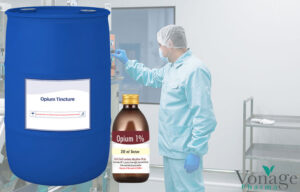
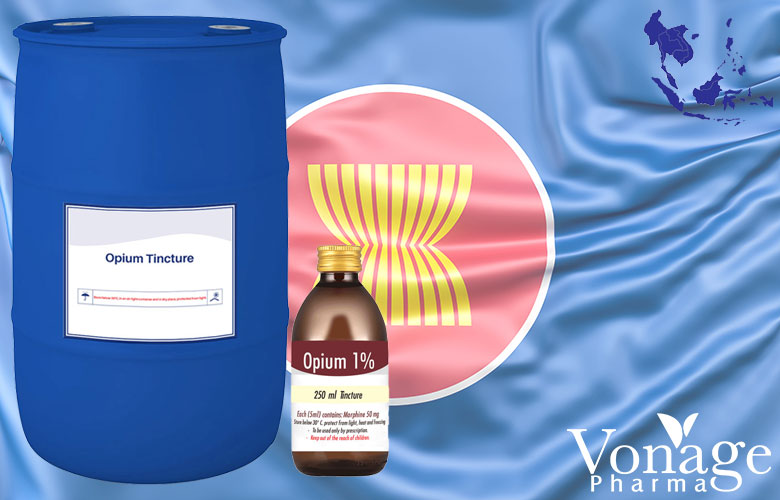
Vonage Pharma produces Opium Tincture in bulk for pharmaceutical providers, supporting B2B procurement and international pharmaceutical supply requirements.
Its opioid portfolio includes Opium Tincture 1%, Opium Powder API, and an Opium Tincture 1% bottle format. Vonage Pharma also lists Opium Tincture within its pharmaceutical API portfolio.
Opium Tincture Regulations: Vonage Pharma’s Opioids Category
Vonage Pharma has developed a dedicated Opioids category for pharmaceutical providers seeking controlled opioid APIs and finished dosage forms.
The portfolio includes:
- Buprenorphine Base
- Buprenorphine HCl
- Codeine Phosphate
- Methadone HCl
- Morphine Sulfate
- Nalbuphine
- Naloxone HCl
- Naltrexone HCl
- Opium Powder API
- Opium Tincture
- Oxycodone HCl
- Thebaine Base
- Tramadol HCl
Vonage Pharma’s finished dosage portfolio also includes opioid products such as buprenorphine sublingual tablets, buprenorphine/naloxone tablets, methadone tablets and oral solution, naltrexone tablets, and Opium Tincture 1% Bottle.
This gives pharmaceutical providers access to a broader controlled-opioid manufacturing platform rather than sourcing individual products from unrelated manufacturers.
Opium Tincture Regulations: Choosing a Pharmaceutical Provider
For controlled pharmaceutical products, supplier evaluation should extend beyond price.
B2B buyers should consider:
- GMP manufacturing capabilities
- Controlled-substance experience
- Batch consistency
- Quality-control procedures
- Technical documentation
- Regulatory support
- Production capacity
- Export capabilities
- Supply continuity
- Packaging and logistics capabilities
These factors can become particularly important when entering markets where multiple licenses and permits are required.
Vonage Pharma is positioned as a bulk Opium Tincture provider for pharmaceutical companies, combining Opium Tincture production with a wider opioid API and finished-dose portfolio.
Opium Tincture Regulations: Final Considerations for ASEAN Buyers
The most important takeaway from the opium tincture regulations landscape is that ASEAN should be approached as a group of individual national regulatory markets.
Malaysia regulates opium and dangerous drugs under the Dangerous Drugs Act. Singapore maintains strict controlled-drug licensing requirements. Thailand classifies medicinal opium as a Category 2 narcotic, while Indonesia maintains detailed national narcotics classifications covering opium and Papaver somniferum.
For B2B pharmaceutical providers, the correct approach is to establish the product’s legal classification, verify country-specific requirements, obtain the necessary licenses and permits, prepare complete technical documentation, and work with a manufacturer capable of maintaining consistent quality and controlled-substance supply.
With bulk Opium Tincture production and a dedicated Opioids portfolio covering APIs and finished dosage forms, Vonage Pharma provides pharmaceutical providers with a specialized B2B manufacturing and supply option for controlled opioid products.